Defence Monitor

spacecraft

NASA asks US industry to develop spacecraft to safely deorbit space station

NASA asks US industry to develop spacecraft to safely deorbit space station

Washington, Sep 21, NASA has issued a proposal to the US industry to plan and develop a US Deorbit Vehicle (USDV) to help in safely deorbiting the International Space Station (ISS). The USDV is a spacecraft meant to safely deorbit the ISS as part of its planned retirement in 2030. According to NASA, a new spacecraft solution would provide more robust capabilities for responsible deorbit. The agency said USDV will be a new spacecraft design or modification to an existing spacecraft that must function on its first flight and have sufficient redundancy and anomaly recovery capability to continue the critical…
Read More
SpaceX completes Falcon 9 static fire test ahead of Crew-1 launch

SpaceX completes Falcon 9 static fire test ahead of Crew-1 launch

Washington: The SpaceX Falcon 9 rocket and Crew Dragon spacecraft that will launch four astronauts to the International Space Station, the Crew-1 mission, has completed a key prelaunch milestone, the integrated static fire.Crew Dragon is targeting launch on a Falcon 9 on Saturday at 7.49 p.m. EST from Launch Complex 39A at NASA's Kennedy Space Center. "Static fire of Falcon 9 complete -- targeting Saturday, November 14 at 7.49 p.m. EST for launch of Crew Dragon's first operational mission to the @space_station with four astronauts on board," SpaceX said in a tweet on Thursday."Teams will continue monitoring weather conditions for liftoff…
Read More
‘Reducing Chandrayaan-2 Orbiter’s orbit may be dangerous’

‘Reducing Chandrayaan-2 Orbiter’s orbit may be dangerous’

Chennai: Reducing the orbit of Chandrayaan-2 Orbiter to pick up any weak signals or to take a closer look the moon lander Vikram that had crash-landed on the lunar surface is a dangerous move, contend space scientists.According to sources, the Indian Space Research Organisation (ISRO) is looking at reducing Chandrayaan-2 Orbiter's orbit from 100 km to 50 km above the lunar surface."Reducing the orbit of the Orbiter is a dangerous idea," a former space agency official, speaking on condition of anonymity, told IANS. "What is ISRO going to gain by this move is not known. Even if the Orbiter is able…
Read More
Russian spacecraft with humanoid robot docks at ISS

Russian spacecraft with humanoid robot docks at ISS

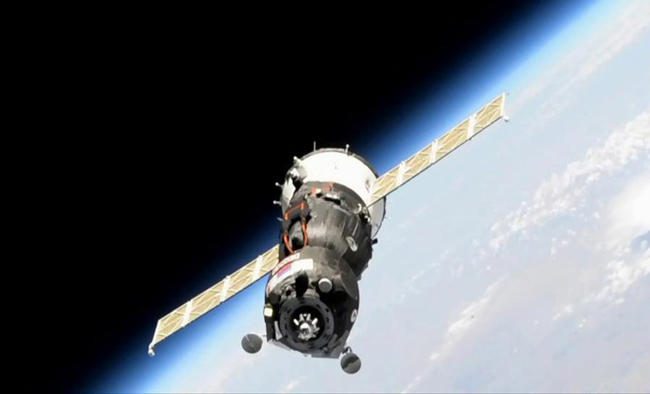
Moscow: A Russian Soyuz spacecraft carrying a humanoid robot successfully docked with the International Space Station (ISS) on Tuesday following a failed attempt."The docking has taken place," said the Mission Control Centre. The docking of Soyuz MS-14 spacecraft with the Russian Fedor, short for Final Experimental Demonstration Object Research, robot took place several minutes ahead of the schedule, it said.The docking was rescheduled after a failed attempt on August 24. During the first attempt of docking, a fault occurred in the ISS equipment responsible for the safe approach and airlocking, and then the Mission Control Centre decided to withdraw the spacecraft to…
Read More
Chandrayaan-2 successfully enters 2nd Lunar orbit

Chandrayaan-2 successfully enters 2nd Lunar orbit

Chennai: The second Lunar orbit manoeuvre for Chandrayaan-2 spacecraft was successfully completed on Wednesday, said India Space Research Organisation (ISRO).According to ISRO, the orbit manoeuvre began at 12.50 p.m. and took 1,228 seconds to complete. The orbit achieved is 118 km X 4,412 km.All spacecraft parameters are normal. The next Lunar bound orbit manoeuvre is scheduled on August 28, 2019 between 5.30 a.m. - 6.30 a.m.On Tuesday, the Chandrayaan-2 was put into its first Lunar orbit.On July 22, the Chandrayaan-2 was injected into an elliptical orbit of 170X45,475 km by India's heavy lift rocket Geosynchronous Satellite Launch Vehicle-Mark III (GSLV Mk…
Read More

India’s Chandrayaan-2 on course to Moon

Chennai: The Indian space agency on Tuesday completed successfully the crucial orbit manoeuvre and put the Chandrayaan-2 spacecraft into the lunar orbit.According to Indian Space Research Organisation (ISRO), the Lunar Orbit Insertion (LOI) was completed successfully at 9.02 a.m. as planned using the onboard propulsion system. All the systems of Chandrayaan-2 are healthy. "The duration of manoeuvre was 1,738 seconds. With this, Chandrayaan-2 was successfully inserted into a lunar orbit. The orbit achieved is 114km X 18,072km," the ISRO said.Following this, a series of orbit manoeuvres will be performed on Chandrayaan-2 spacecraft to enable it to enter its final orbit passing…
Read More
Chandrayaan-2 enters Lunar Transfer Trajectory

Chandrayaan-2 enters Lunar Transfer Trajectory

Chennai: India's spacecraft to the moon Chandrayaan-2 on Wednesday successfully entered the Lunar Transfer Trajectory (LTT) after its orbit was raised further, said Indian space agency.According to Indian Space Research Organisation (ISRO), the final orbit raising manoeuvre of Chandrayaan-2 was successfully carried out at 2.21 a.m. by firing the spacecraft's motors for 1,203 seconds."With this, Chandrayaan-2 entered the Lunar Transfer Trajectory. Earlier, the spacecraft's orbit was progressively increased five times during July 23 to August 06, 2019," ISRO said. The health of the spacecraft is being continuously monitored from the Mission Operations Complex (MOX) at ISRO Telemetry, Tracking and Command Network…
Read More

NASA mission picks 4 sites for asteroid Bennu sample return

Washington: After grappling with the rugged reality of asteroid Bennu's surface, NASA, the US space agency, has finally selected four potential sites for its spacecraft to "tag" its cosmic dance partner.Since its arrival in December 2018, the OSIRIS-REx spacecraft has mapped the entire asteroid in order to identify the safest and most accessible spots for the spacecraft to collect a sample. These four sites now will be studied in further detail in order to select the final two sites -- a primary and backup -- in December, NASA said in a statement on Tuesday."We knew that Bennu would surprise us, so…
Read More
Chandrayaan-2 to reach moon by August 20: ISRO

Chandrayaan-2 to reach moon by August 20: ISRO

Chennai: India's second moon spacecraft Chandrayaan-2 put into earth orbit on July 22, is scheduled to reach the Moon by August 20, the Indian space agency said on Wednesday.The Indian Space Research Organisation (ISRO) said that the first-earth bound orbit raising manoeuvre for Chandryaan-2 was successfully performed on Wednesday afternoon by firing the onboard motors for 57 seconds.The new orbit is 230x45,163 km. The second orbit raising manoeuvre is scheduled on July 26, at 1.09 a.m., it added. On July 22, the Chandrayaan-2 was injected into an elliptical orbit of 170x45,475 km by India's heavy-lift rocket Geosynchronous Satellite Launch Vehicle-Mark III…
Read More
India’s tryst with destiny: ‘Bahubali’ puts Chandrayaan-2 into orbit

India’s tryst with destiny: ‘Bahubali’ puts Chandrayaan-2 into orbit

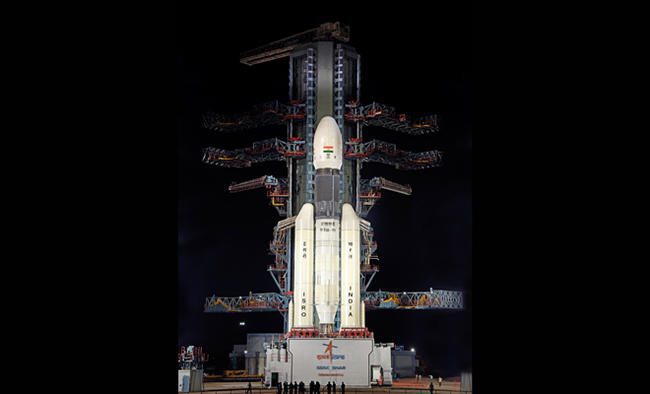
Sriharikota (Andhra Pradesh): India's second lunar mission was on track as its 'Babubali' GSLV rocket successfully put the moon spacecraft -- Chandrayaan-2 -- into the orbit in a copy book style on Monday afternoon.The Rs 375 crore, heavy lift GSLV-Mk III rocket slung the Rs 603 crore, 3.8 tonne Chandrayaan-2 spacecraft in its intended earth parking orbit. The 43.4 metre tall, 640 tonne rocket, nicknamed 'Bahubali', carried the 3.8-tonne Chandrayaan-2 spacecraft, which will carry out India's second mission to its closest celestial neighbour.From here, it will be a long, over one-and-a-half-month journey for Chandrayaan-2 as it will traverse the 384,400 km…
Read More