

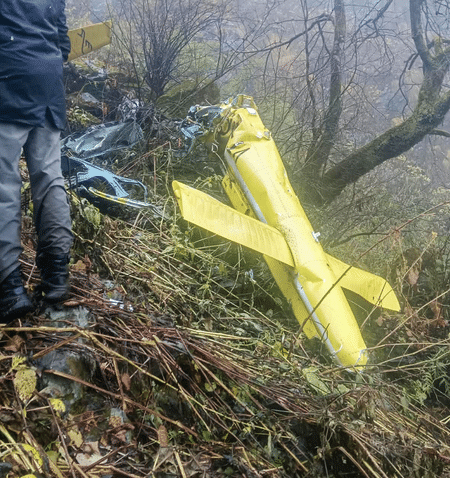
New Delhi, Nov 2 (IANS) The Federation of Indian Pilots (FIP) has sought Prime Minister Narendra Modi’s intervention into the “increasingly disturbing pattern” of helicopter accidents in India, particularly those involving operations in the Himalayan region and high-altitude terrain.
The FIP has written to the Prime Minister in the wake of the tragic helicopter accident in the Joshimath area of Uttarakhand’s Chamoli district on October 30, which claimed the lives of all six occupants on board.
This tragedy is particularly disturbing when viewed against the backdrop of several helicopter accidents in Uttarakhand and other parts of the country in recent years. The recurrence of such accidents, some involving multiple fatalities, raises serious questions regarding the adequacy of existing operational procedures, pilot training, weather assessment, terrain clearance, helipad infrastructure, operator oversight, and the effectiveness of the safety management systems governing helicopter operations, it pointed out in its letter.
The FIP said it “firmly believes that the time has come for the Ministry of Civil Aviation and DGCA to undertake a comprehensive examination of helicopter operations in India, especially in the hills, which has also been flagged in the 380th Report of August 2025 by the Department-Related Parliamentary Standing Committee on Transport, Tourism and Culture with background of a series of accidents during high-risk Char Dham Yatra operations”.
The letter points out that in the Kedarnath sector, the terrain is fully mountainous with narrow and steep valleys, with operating altitude between 8,000-12,000 feet and can be classified as a Hostile Environment according to DGCA norms. A safe forced landing cannot be accomplished because the surface and surrounding environment are inadequate.
Most of the helipads have Unidirectional Approach/Take off funnel. Minimum 150 degrees separation between landing and takeoff funnel is not available and not followed.
Due to the unidirectional funnel, most of the time, either take-off or landing is carried out in tailwind conditions, which is very dangerous given the thin engine power margin and sluggish controllability of the helicopter at those high altitudes.
The helicopters being used in Char Dham are all single-engine, performance Class 3 Helicopters, only VFR capable, have no autopilot, have no weather radar, and are flown by a single pilot, the FIP noted.
Since for VFR, autopilot and weather radar are not required, no machine is equipped with them.
It also highlights that for operations in Performance Class 3, in the event of an engine failure at any time during the flight, a forced landing will be required.
Since the operating area is a “Hostile Environment” and a forced landing field is not available for all phases of flight, operation of a Performance Class 3 Helicopter is unsafe and unsuitable for operations in this region.
Helicopter operations are inherently different from fixed-wing Airline Operations. They involve low-level flying, operations at confined and elevated landing sites, rapidly changing weather, proximity to terrain and obstacles, demanding take-offs and landings, and frequent exposure to environmental conditions that may change significantly within a short period. The risk becomes even greater in the Himalayan region, where cloud formations, mountain waves, downdrafts, turbulence, wind shear, restricted visibility, and rapidly changing weather can create extremely challenging conditions. The following areas require immediate attention, the FIP noted.
–IANS
sps/vd